Subscribe

RSS Feed (xml)

Powered By

Skin Design:
Free Blogger Skins

Powered by Blogger

Thursday, March 12, 2009

article : Symbiotic Relationships


Symbiotic
Relationship

Living Apart
(Not Interacting)
Organism Organism
A B

Living Together
(Interacting)
Organism Organism
A B


Population Effects

Neutralism 0 0 0 0 Neither population affected
Competition 0 0 - - Elimination of population most affected
Mutualism - - + + Populations must interact
Commensalism - 0 + 0 A must interact;
B not affected
Parasitism - 0 + - A (Parasite) must interact;
B (Host) negatively affected

Designed & Maintained by David M. Rollins
Copyright © 2000, D.M. Rollins and S.W. Joseph
Revised: September 2003
URL: http://life.umd.edu

Read More......

article : Host-Parasite Interaction Basic Definitions


INDEPENDENCE:
living free from the influence, guidance, or control by another organism


SYMBIOSIS:
a relationship in which two dissimilar organisms (SYMBIOTES, SYMBIONTS) live in close association with one another


MUTUALISM:
mutually beneficial relationship between two species


COMMENSALISM:
a relationship between two species in which one is benefited and the other is not affected, neither negatively nor positively


PARASITISM:
a relationship between two species in which one benefits (parasite) from the other (host); usually involves some detriment to the host


BENIGN:
referring to a non-life or non-health threatening condition = COMMENSALISM


MALIGNANT:
a disease tending to become progressively worse (MORBIDITY=illness) and potentially result in death (MORTALITY=death)


CARRIER:
a symptomless individual who is host to a pathogenic microorganims and who has the potential to pass the pathogen to others


PATHOGENICITY:
the quality of producing or the ability to produce pathologic changes or disease


VIRULENCE:
a measure of pathogenicity; a measurement of the degree of disease producing ability of a microorganism as indicated by the severity of the disease produced; a measure of the dosage required to caused a specific degree of pathogenicity --- one general standard is the LD50


DOSAGE:

the number of pathogenic microorganisms entering the host


LD50:
the number of microorganisms required to cause lethality in 50% of the test host


TRUE PATHOGEN:
any microorganism capable of causing disease; an infecting agent


OPPORTUNISTIC PATHOGEN:
a usually harmless microorganism that becomes pathogenic under favorable conditions


INFECTION:
the colonization and/or invasion and multiplication of pathogenic microrganisms in the host with or without the manifestation of disease


COLONIZATION:
the successful occupation of a new habitat by a species not normally found in this niche


MULTIPLICATION:
the ability of a microorganism to reproduce during an infection


DISEASE:
an abnormal condition of body function(s) or structure that is considered to be harmful to the affected individual (host); any deviation from or interruption of the normal structure or function of any part, organ, or system of the body
Designed & Maintained by David M. Rollins
Copyright © 2000, D.M. Rollins and S.W. Joseph
Revised: September 2003
URL: http://life.umd.edu

Read More......

article : Koch's Postulates to Identify the Causative Agent of an Infectious Disease

Koch's Postulates

Four criteria that were established by Robert Koch to identify the causative agent of a particular disease, these include:

  1. the microorganism or other pathogen must be present in all cases of the disease


  2. the pathogen can be isolated from the diseased host and grown in pure culture


  3. the pathogen from the pure culture must cause the disease when inoculated into a healthy, susceptible laboratory animal


  4. the pathogen must be reisolated from the new host and shown to be the same as the originally inoculated pathogen
Designed & Maintained by David M. Rollins
Copyright © 2000, D.M. Rollins and S.W. Joseph
Revised: September 2003
URL: http://life.umd.edu/

Read More......

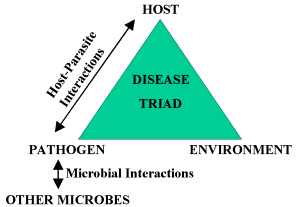
article : Disease Triad


Designed & Maintained by David M. Rollins
Copyright © 2000, D.M. Rollins and S.W. Joseph
Revised: September 2003
URL: http://life.umd.edu

Read More......

article : Schick Test

Schick Test: The intracutaneous skin test introduced by Schick in 1913 that enables us to distinguish between individuals who are susceptible and those who are resistant (i.e., immune) to diphtheria toxin and to test for sensitivity to toxoid. The test is based on the following empirical findings:

    1. Intracutaneous injection of 1/50 MLD (minimal lethal dose) (for a guinea pig) of diphtheria toxin produces a strong, but tolerable, reaction in individuals having no antitoxin.


    2. Individuals having 1/30 unit or more of antitoxin per ml of blood neutralize this test dose and show no reaction. Such individuals are also usually resistant to diphtheria.

REACTIONS TO SCHICK TEST

TOXIN
TOXOID
SKIN RESPONSE
36 h
120 h
36 h
120 h
INTERPRETATION
POSITIVE REACTION
-
+
-
-
Nonimmune, Nonsensitive

NEGATIVE REACTION

-
-
-
-
Immune, Nonsensitive

PSEUDO REACTION

+
-
+
-
Immune, Sensitive

COMBINED REACTION

+
+
+
-
Nonimmune, Sensitive

Designed & Maintained by David M. Rollins
Copyright © 2000, D.M. Rollins and S.W. Joseph
Revised: August 2000
URL: http://life.umd.edu

Read More......

Search by Google

Custom Search
 

Search Engine Optimization - AddMe

Enter your email address:

Delivered by FeedBurner